







2026/03/27
ADVICS has legends—
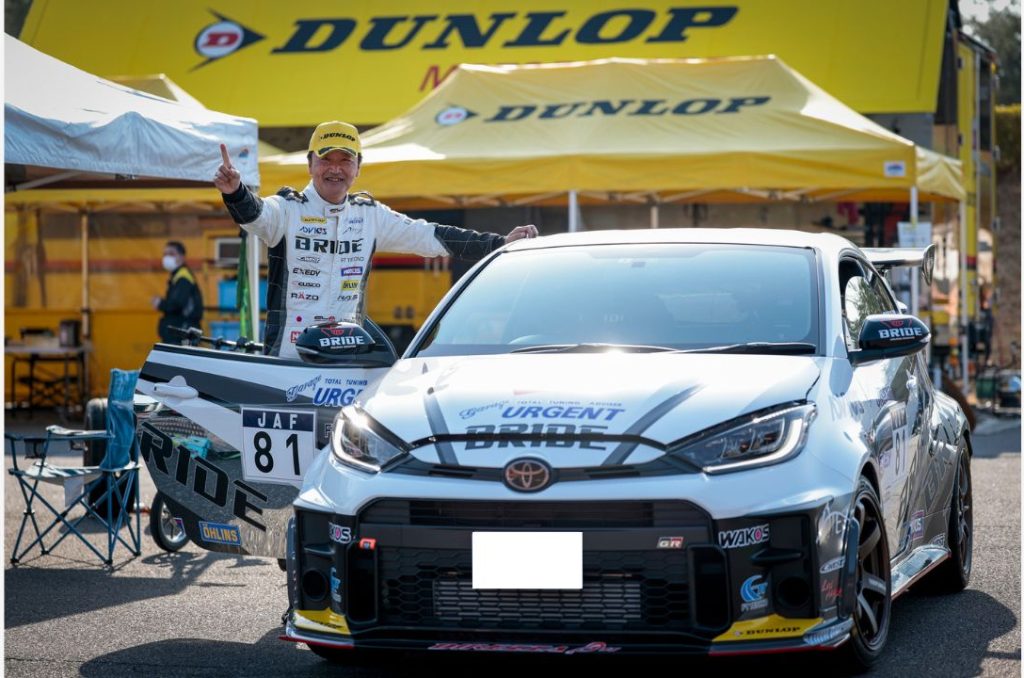
There is a driver who continues to etch his name into the history of the All Japan Gymkhana Championship. He has competed for 37 consecutive years since 1989, boasting a record of over 80 wins and 11 series championships. This is Shinji Tsugawa of the Sports Braking Technology Development Department. What is the secret to his strength? Behind it lies the struggles and challenges that only someone who has spent so many years in the world of competition can know. Here, we will focus on the secret to Mr. Tsugawa's strength.
A mountain pass racer makes a sensational debut in JAF competitions.
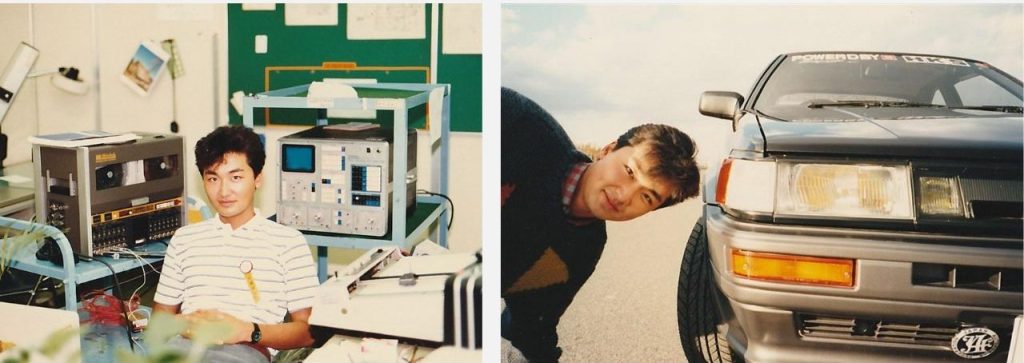
Mr. Tsugawa joined AISIN Co., Ltd. (now AISIN CORPORATION) in 1985. At that time, Japan was experiencing a car boom, and many of his colleagues were car enthusiasts. Mr. Tsugawa's hobbies included tinkering with cars and driving. He obtained his driver's license around this time, and his first car was a Toyota Corolla Levin. (The dealership also had a Toyota Celica, which he wanted, but due to budget constraints, he chose the Levin...)
My passion for driving began when a senior colleague took me for a drive on a mountain pass. I became completely hooked on the joy of driving a car. The feeling of experiencing the limits of a car's performance and the joy of being able to control its behavior with my own will was exceptional! Once I became reasonably fast on mountain passes, I wanted to do something that would leave my mark, so I chose autocross*.
*A motorsport in which a course is created by setting up pylons on a paved open space or mini-circuit, and cars race one by one to compete for the best time.
The glory and the struggles that come with it. The meaning of a long and successful career.
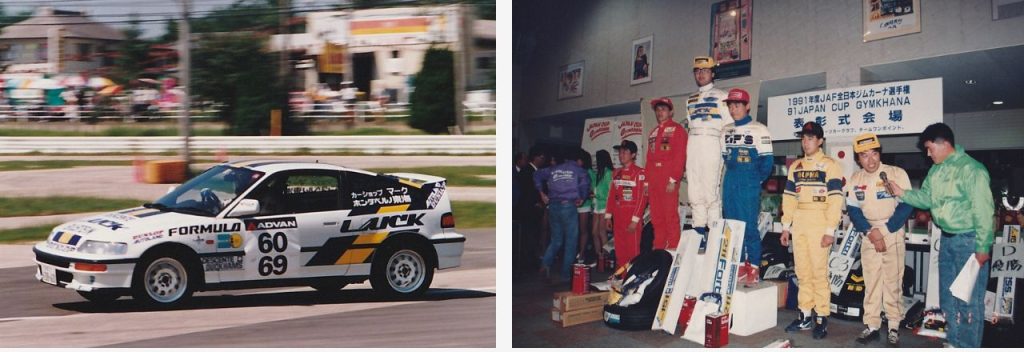
He began competing in gymkhana competitions (Chubu Regional Championship) in 1987. From 1989, he gained experience competing in the All Japan Championship, achieving an excellent second place in his debut, and winning the series championship in 1991. He made a name for himself nationwide as a "young talent." He continued to rack up victories throughout the 2000s, winning the championship multiple times. His achievements and technical skills were recognized, and he was entrusted with the role of development driver for sponsoring companies such as tire manufacturers. This comes with the responsibility and trust that comes with being seen as the face of the manufacturer, and is also proof that he has the potential to win and the ability to develop products.
However, this glory was by no means the beginning of a smooth-sailing career. Rather, it marked the start of a seemingly endless journey of challenges and struggles.
From a certain year onward, he went through a period of frustration, consistently finishing second or third, always just one step away from victory. The more he won, the more expectations were placed upon him, and as his career progressed, the pressure of "winning is expected" and "he's a development driver for the manufacturer" weighed heavily on him, making even the smallest mistakes a reason to blame himself. Furthermore, in addition to the daily struggles of not being able to secure wins, he was also at the mercy of changing machine characteristics and the emergence of new rivals, and the pressure of "as a veteran, I can't afford to fall behind" tormented him.
At that time, I was working at the company analyzing the control waveforms of actual vehicles for ABS, and when ADVICS was founded, I was promoted to a core position and transferred there.
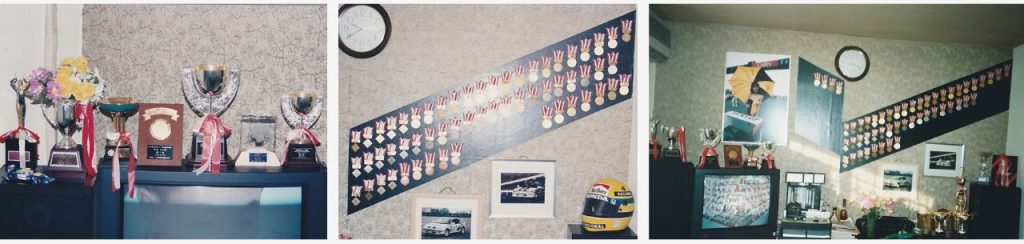
An indomitable spirit forged by overcoming obstacles.
Even as pressure piled up, there was one thing that Mr. Tsugawa never let go of: his "attitude of inquiry."
"I've come to realize that increasing my repertoire of running techniques is the key to quickly overcoming obstacles when you hit a wall."
The pursuit of the perfect setting for the course and surface is endless, and even if we win, we don't necessarily consider it the right answer. Even if we achieve the fastest time in a test run, we don't rest on our laurels, but deliberately change the settings and continue to explore directions we haven't tried before. When we actually run the car, it's not uncommon for the results to be as bad as expected. However, this repetition of trial and error becomes a valuable asset, accumulating essential know-how that leads to the next step. Even if it's a failure, by accumulating new experiences one by one, countless options grow within us. That's why we can come up with a solution in any situation.
Also, the competition time for each person in a gymkhana is about 1 minute and 30 seconds. In this short time, you have to put everything you've practiced into practice, so you can't win unless you have not only skill but also strong mental fortitude. When I was younger, I used to tell myself, "Nobody is watching my driving, so there's no need to be nervous." Now that I'm a top driver, it's a well-known fact that many people are watching, whether it's in the gallery or through live streaming. I train my mental strength by telling myself, "No matter how many people are watching, I can definitely drive with a calm mind!" (I guess the only way to do this is to gain experience!)
It was during the painful period of not being able to win that he honed his indomitable spirit, never giving up and continuing to challenge himself. This strength was the driving force that propelled Mr. Tsugawa forward throughout his long career. After that, he successfully overcame his slump and maintained an impressive record of five consecutive series championships, achieving a truly magnificent comeback.
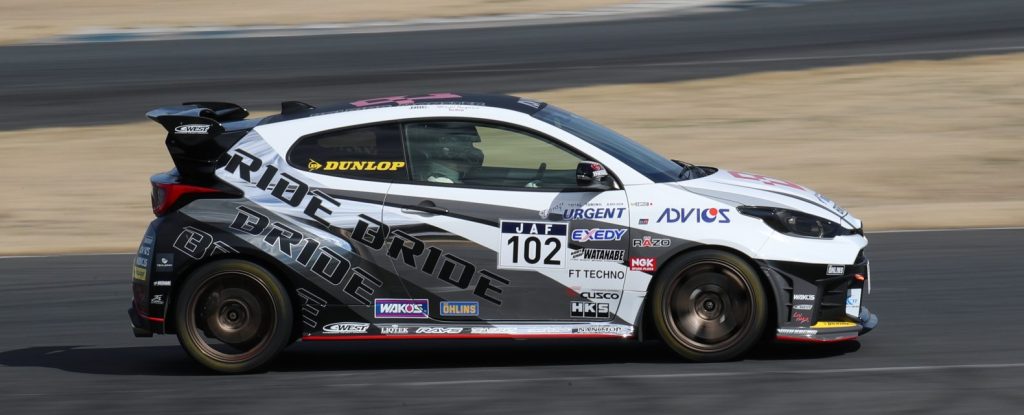
Applying the knowledge gained from competition to work, and utilizing the experience gained from work in competition as well. This is the pride of a legend.
Mr. Tsugawa has gained experience in multiple departments, including the Reliability Engineering Department, the Motorsports Division, and the Sports Braking Technology Development Department. In the Reliability Engineering Department, he advised on the direction of brake feel as a brake audit driver for mass production development, and in the Motorsports Division and the Sports Braking Technology Development Department, he served as an evaluation driver for aftermarket brake pad development. He has consistently fed back the keen senses he cultivated in competition into product development.
Brakes aren't simply about "working well"; they require delicate and precise control in a realm where acceleration, deceleration, and lateral G-forces overlap in complex ways. The braking force builds up exactly as the driver envisions in response to pedal pressure and stroke, and the braking force releases smoothly when the pedal pressure is slightly released.
Currently, the Sports Braking Technology Development Department aims to adopt standard brakes for the next-generation sports car that can be enjoyed both on city streets and on the racetrack. In this development activity, Mr. Tsugawa is in charge of performance evaluation, determining the balance between the product and the vehicle. Performance evaluation requires a wide range of knowledge, from general driving to sports driving, but being able to empathize with the feelings of users who particularly enjoy sports driving is only possible thanks to the sensitivity and experience honed through many years of competitive driving. He is able to bring the knowledge gained from competition back into development, and conversely, there are many instances where the experience gained at work is put to use in competition. Depending on the compatibility between the pads and ABS, the expected deceleration may not be achieved, so he reads the situation from the data and adjusts it to the optimal balance, and since the front-to-rear balance of braking force can make a car perform better or worse on different courses, he adjusts the settings for each course, leaving no stone unturned in his approach.
The knowledge gained from competition is applied to work, and the experience gained from work is applied to competition. This continuous cycle is the driving force behind the creation of high-quality products. Mr. Tsugawa's success in the All Japan Gymkhana Championship is not only a challenge for himself, but also brings tangible value to our manufacturing process.